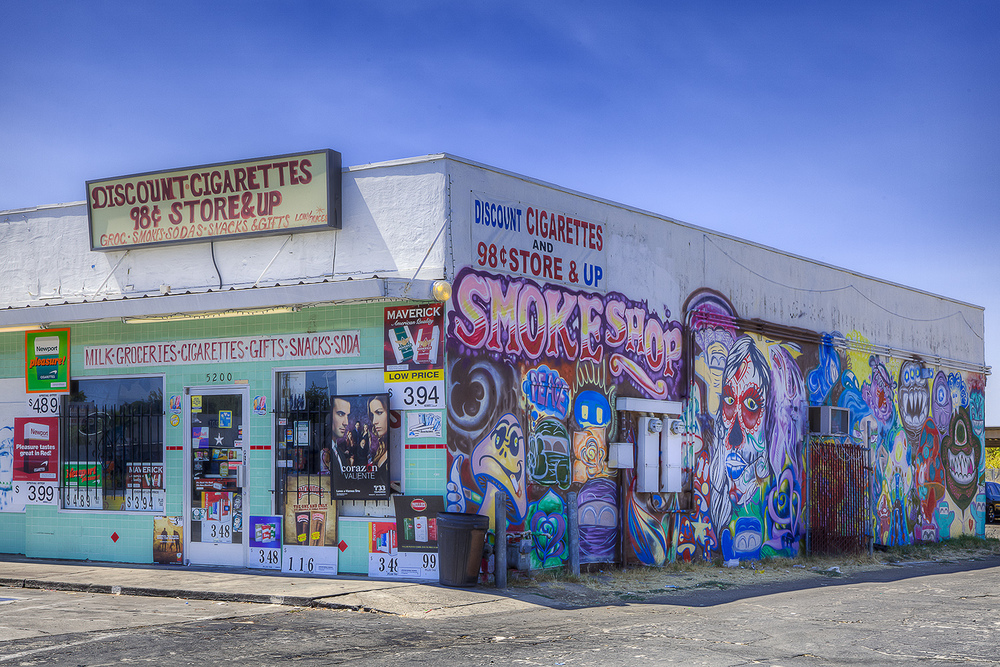
Showing posts with label ESC. Show all posts

Other Cities Lead While Sacramento Just Pretends

Sacramento Leaders Don't Understand Simple Math
Sacramento is the capitol of the most productive state in the United States. Within the last 10 years, California was the 6th largest economy in the world, surpassing developed countries of global significance such as Italy and Russia. One would think that the capitol city of that powerhouse should be strong and vibrant, a beacon of hope and prosperity.

However, Sacramento's leadership over that time has done an abysmal job of investing in city infrastructure, building safe communities, and promoting an inviting environment for job creation. What's worse, city leaders continue to ignore the voice of the people and pursue a losing strategy. Not only should Sacramento voters get more engaged in City planning, the City Council and Mayor should consider it their duty to reach out to the public ... not ignore them.


Other effective City Council Members are doing just that - asking residents what they need. In the City of Long Beach, Rex Richardson has taken a portion of the city budget, dedicated it to infrastructure investment, and held community meetings to set priorities for these expenditures. There are countless other strategies that can help local governments encourage citizen participation. The Municipal Research and Services Center (MRSC) researches, compiles, and provides for free packages of strategies and materials for use by local governments.

MRSC notes, "formal city hall and courthouse settings can be intimidating, and hearings can sometimes be dominated by those who are more comfortable with public speaking. Such hearings may not be the best way to encourage comment from a wide cross-section of community residents and may not fit into citizens' busy schedules. The format of hearings often leaves little, if any, room for reasonable discussion, give or take, or response to prior testimony. Instead, it is important to conduct a thoughtful public process in advance of the public hearing."
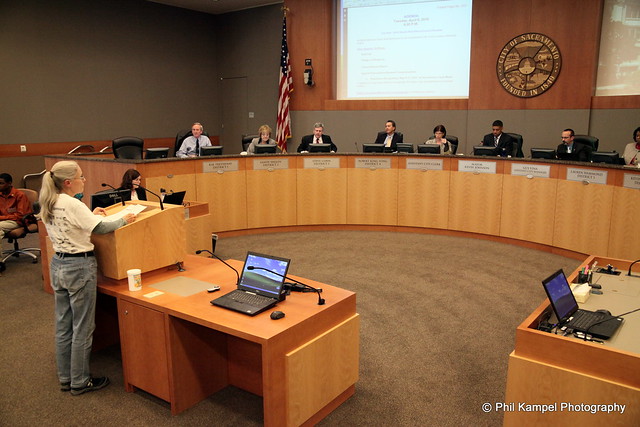
Would You Feel Intimidated?
 Oddly, Mayor Kevin Johnson is the current President of the United States Conference of Mayors (USCM) - an organization that itself gathers and provides best practices for local governments. So, one would wonder why he and his city don't follow many of them...

A myriad of other sources of information are also available to City Leaders, if they could just get past their own egotistical self indulgence. For instance, a survey of more than 13,000 small business owners was conducted, asking what policies make a city business friendly. Sacramento was ranked #82 on the list of lowest rated cities in the country. A thoughtful City Leader should consider its business environment, particularly when Sacramento faces higher unemployment than cities both to the East and West - higher than the state average, even. One vital finding of the survey was that the effects of poor licensing regimes (at all levels of government) were twice as important as taxation, and that easily understood tax regimes were at least as important as low taxes.


If City Leaders listened more to what residents need, and small business owners want, maybe the 2035 General Plan Update would have been more on point.  There's still time to change direction.

Low Income and Jobless Forgotten as City Leaders go Pinky-Up


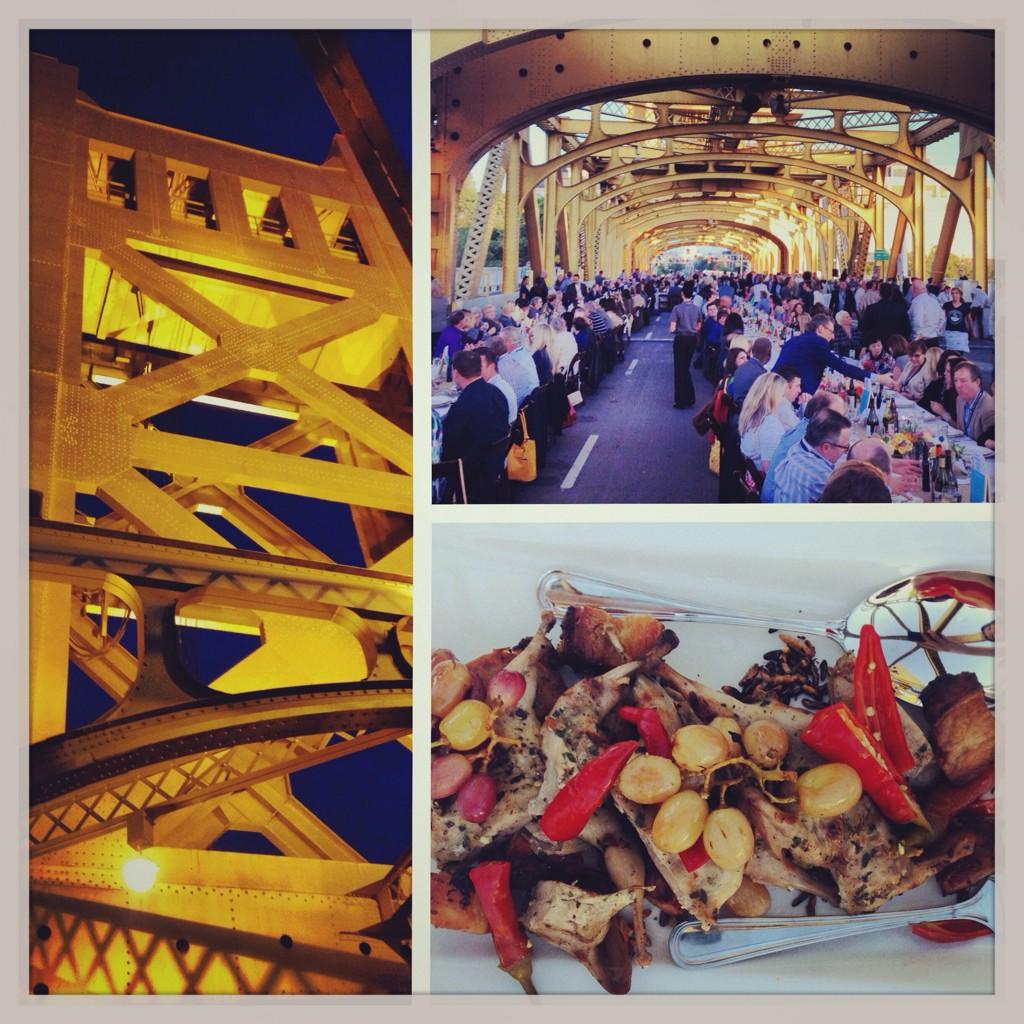
Last weekend, Sacramento City leaders shut down the Tower Bridge to host Sacramento elite at a dinner to celebrate their self-designated "Farm to Fork Capitol" of America. This gala dinner, which cost between $175 and $625 per person (depending on how close to the King you wanted to sit), capped off two weeks of self-indulgent faux service to the Sacramento community. Sacramento's leading couple, Kevin Johnson and Angelique Ashby were in attendance.


The inappropriateness of this event was noted in the Sacramento Bee and Sacramento News & Review, among other places. Each recognized that with a median household income of $55,000, farm to fork groceries are a stretch on the budget, and this event was just over-the-top.

What this celebration highlighted most of all is the low wages and poverty that pervades significant portions of Sacramento. In the City of Sacramento, more than one-fourth of residents live below the poverty level, compared to one-fifth statewide. Local farmers markets throughout our communities have been a welcome staple of Sacramento since long before City leaders decided to politically capitalize on the backs of local growers. However, fresh fruits and vegetables, grass-fed beef, and ranch-made cheese and butter are normally too pricey for struggling families to eat more than a couple times each month.


Promoters of "organic" produce and locally grown products tend to brush aside this simple economic fact, saying, "sure it's a little more expensive, but it's better for you". For families who know exactly how much money is in their bank account - to the penny - because they need every penny to eat and survive, eating "better" just isn't part of the equation. The struggle is to survive, and City leaders aren't helping ease that struggle.

If City leaders are going to go through the time, expense, and public inconvenience of holding a two-week festival and shutting down a major thoroughfare in Sacramento, shouldn't that event focus on creating jobs and economic opportunities for the 40,000+ Sacramentans unemployed and looking for jobs, or the 58,000 Sacramentans out of work and collecting social security disability? City leaders regularly extol the virtues of Farm to Fork, a new Entertainment Sports Complex, and recently a new MLS Soccer Stadium, but when was the last time you heard them talk about the rest of us.


The rest of us are those that are taking care of our families and making ends meet. The rest of us are the 125,000 that are struggling with a wage less than $24,000/yr for a family of four (25.6%). The rest of us are the 40,000 that are out of work, but desperately looking for a job (8.4%). The rest of us are the thousands of college graduates that must spend two hours of their day (that could be spent with family) commuting to the bay area, because there are no opportunities for them in Sacramento.

The rest of us aren't paying for the privilege of sitting next to the man who wants all of the power (http://yesonmeasurel.org/), and the rest of us aren't developers making billions on large City-promoted projects. The rest of us are voters and taxpayers, though.


The Future of Sacramento Development - General Plan Update 2035

Another key component to Sacramento's future success is planning for development.  This is the second article discussing the 2035 General Plan Update released in August 2014.

According to city leaders, the city intends to "encourage compact, higher-density development..." (LU 1.1.1).  Throughout the city, they intend to build up - not out.  The premise behind such a proposal is that not enough Sacramentans live in multi-unit apartment buildings.  Among the stated purposes for this requirement to increase density are:  supporting transit, reducing vehicle trips, promoting pedestrian/bicycle friendly neighborhoods, and increasing housing diversity.

Sacramento's Big City Skyline
Now I, personally, want to see Sacramento make the transition into "big city" status.  There is currently estimated to be more than 475,000 residents in the City of Sacramento.  There are only a handful of cities in California bigger than Sacramento, as reported by the California Department of Finance.  This places Sacramento as the 7th largest city in California, following:  Los Angeles (3,904k), San Diego (1,345k), San Jose (1,000k), San Francisco (836k), and Fresno (515k).

A whole different "cowtown" world
But, in order to break into big city status alongside northern California giants like San Francisco and San Jose, there must be fundamental change - change that has long been met with less-than-enthusiastic response from residents who like to think of Sacramento as a "cow town" (see Here, Here and Here).  There's something to be celebrated about having a reputation for nice people, slower pace, and urban farms and livestock.


When you get down to it, here's the crux of the argument for greater infill development and higher housing densities.  The percentage of buildings with five or more units in Sacramento is about 22.5% - Now, compare this with Los Angeles (45.5%), San Diego (35.5%), San Jose (25%), and San Francisco (45.5%).  It simply can't be said that the City's skyline rivals that of San Francisco, San Jose or Los Angeles.


City leaders have a schizophrenic vision of shedding Sacramento's cow town reputation in favor of tightly-packed residents, robust transit and non-motorized transportation options, while still promoting agriculture (lately with the "Farm to Fork" fad) and open space (LU 2.3.1).  It makes one wonder whether they're trying to appease the voters (who like the "small town" feel), while still pushing a big city agenda.

City Leaders Focus Too Much on Downtown

Everyone in Sacramento knows that K-Street and the Downtown Mall have been blighted and in need of revitalization for several decades.  I think we all agree that something should be done to help bring the centrer of our city back into positive repute.

However, the immense focus on building an Entertainment Sports Complex (ESC) has come at the detriment of the rest of the city.  The city will spend at least $250 million in taxpayer dollars on this project.  We can (and have) debate extensively whether this expenditure of public funds is in the best interest of the city, but let's set that conversation aside for a moment.


Do you live along Franklin Blvd. or Florin Road?  How much do you think the city could revitalize your community, bring business investment, and create high-wage jobs with an investment of $250 million into your neighborhood? How about your community schools ... are they in good repair?  The state might owe schools money, but that doesn't mean our communities should have to wait for Darrell Steinberg and Roger Dickinson to pony up.


How about those of you who live in Del Paso Heights?  How much community service, gang intervention, improved transportation and employment assistance could the city provide you with $250 million?  What if local entrepreneurs were given economic incentives to open and renovate small businesses that would employ young community members?

And even the less impoverished neighborhoods of Sacramento have been left in the dust.  Consider the rising crime and business failures in South Natomas and North Natomas.


Parks for the local community have gone untended and without repairs or improvements.  Community leaders renovated one park in the region and congratulated themselves extensively for this minor accomplishment.  Storefronts continue to sit empty, despite announcements that Sacramento's economy is recovering.  And now that redistricting has occurred, this part of the city is "divided and conquered" between the downtown interest (Councilmember Steve Hansen) and the East Sacramento elite (Councilmember Steve Cohn).

And then there's North Natomas - a relatively new community in Sacramento, but with great strategic and growth opportunities.  North Natomas will be the biggest loser when the ESC is completed, with all entertainment benefits moving from Arco Arena (Sleep Train), and no substantive plans for developing an economic engine to replace it.


All throughout the community, office buildings like this one stand empty.  No businesses are being courted to fill these spaces, and no strategic plan is in development to bring a significant economic engine to this prime land, located between the International Airport, City and State Government Buildings, and along three of the main economic corridors on the west coast.

It bears mentioning that Mayor Pro Tem Angelique Ashby is begging Kaiser Permanente to put a facility at the Arco Arena site.  More on this plan in another post.


So, what's a city to do?  There's little use in complaining that the rest of Sacramento is being left behind if we don't offer solutions.  But ... of course ... solutions cost money.  And now that Sacramento leaders have mortgaged the near future (to the tune of $250,000,000), money would seem to be a problem.

Government investments in infrastructure always have the highest return on the investment.  Whether this infrastructure is roads, transit, schools, high-speed internet, electricity and water improvements, sewer, libraries, or any other such community need.  I think we could say that at least the Sacramento City Council got something right when deciding to use the money to build something, instead of pour it down the drain into "re-branding" Sacramento without providing any new incentive to live, work, or play here.


Beyond investments to maintain and improve Sacramento infrastructure, investment in business of all kinds is imperative to building a world-class economy.  A very quick Google search shows that the cities of Philadelphia, PA; Dallas, Tx; Baltimore, MD; Lousiville, KY; New York City, NY; San Jose, CA; and San Francisco, CA all have local tax incentives to attract business investment.  Sacramento, however, does not, relying exclusively on whatever state and federal opportunities might be available.  Opportunities that could be had anywhere else but here.


It's clear that city leaders need to shake off the starstruck veils pulled over their eyes by the NBA, and get back to tending to the whole city.  The ESC will move forward according to a schedule established by legal, environmental and other barriers.  We need the Mayor and City Council to make the rest of us a priority too.


I'll close this out with a little reading material.

Investing in the Future:  An Economic Strategy for State and Local Governments in a Period of Tight Budgets

February 2011

×