Showing posts with label tax. Show all posts

City Council Gives Themselves 6% Raise (Budget Part 1)

Last week Sacramento's proposed 2015-16 budget was released for public comment. The contents of that budget tell an interesting story about the priorities of the City Council - A story that doesn't support the rhetoric coming from our elected officials.

City of Sacramento Seal


The proposed budget "reflects adopted Council priorities" and amounts to almost $1 billion - that's almost $2,000 for every man, woman and child in Sacramento. Think for a moment ... what could you do for your family, and what kind of amazing vacation could you take, if you had $2,000 extra for each person in your family?  But I digress.

So what exactly is the City proposing to do with all of that money taken from you in taxes and fees? Well, to start with, each Council Member will increase their own budget by 6%, or about $25,000 over last year's approved amount. That's right, you're paying more in Measure U taxes so that they can fatten their own budgets. Between the Mayor and City Council, there is a proposed increase of over $790,000 from the last approved budget.

Money From The Sky

When was the last time you got a 6% raise at work? And what exactly are the City Council doing to deserve such a pay increase? That is what the rest of this series intends to answer.


Other Cities Lead While Sacramento Just Pretends

Sacramento Leaders Don't Understand Simple Math
Sacramento is the capitol of the most productive state in the United States. Within the last 10 years, California was the 6th largest economy in the world, surpassing developed countries of global significance such as Italy and Russia. One would think that the capitol city of that powerhouse should be strong and vibrant, a beacon of hope and prosperity.

However, Sacramento's leadership over that time has done an abysmal job of investing in city infrastructure, building safe communities, and promoting an inviting environment for job creation. What's worse, city leaders continue to ignore the voice of the people and pursue a losing strategy. Not only should Sacramento voters get more engaged in City planning, the City Council and Mayor should consider it their duty to reach out to the public ... not ignore them.


Other effective City Council Members are doing just that - asking residents what they need. In the City of Long Beach, Rex Richardson has taken a portion of the city budget, dedicated it to infrastructure investment, and held community meetings to set priorities for these expenditures. There are countless other strategies that can help local governments encourage citizen participation. The Municipal Research and Services Center (MRSC) researches, compiles, and provides for free packages of strategies and materials for use by local governments.

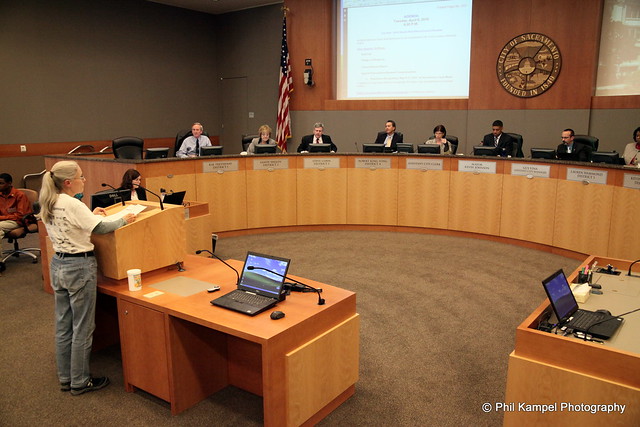
MRSC notes, "formal city hall and courthouse settings can be intimidating, and hearings can sometimes be dominated by those who are more comfortable with public speaking. Such hearings may not be the best way to encourage comment from a wide cross-section of community residents and may not fit into citizens' busy schedules. The format of hearings often leaves little, if any, room for reasonable discussion, give or take, or response to prior testimony. Instead, it is important to conduct a thoughtful public process in advance of the public hearing."

Would You Feel Intimidated?
 Oddly, Mayor Kevin Johnson is the current President of the United States Conference of Mayors (USCM) - an organization that itself gathers and provides best practices for local governments. So, one would wonder why he and his city don't follow many of them...

A myriad of other sources of information are also available to City Leaders, if they could just get past their own egotistical self indulgence. For instance, a survey of more than 13,000 small business owners was conducted, asking what policies make a city business friendly. Sacramento was ranked #82 on the list of lowest rated cities in the country. A thoughtful City Leader should consider its business environment, particularly when Sacramento faces higher unemployment than cities both to the East and West - higher than the state average, even. One vital finding of the survey was that the effects of poor licensing regimes (at all levels of government) were twice as important as taxation, and that easily understood tax regimes were at least as important as low taxes.


If City Leaders listened more to what residents need, and small business owners want, maybe the 2035 General Plan Update would have been more on point.  There's still time to change direction.

City Leaders Miss the Mark with General Plan Update


Last Thursday, the City of Sacramento released its 2035 General Plan Update.  This article is the first of several to be written over the next month delving into details of the City's long-range planning.

Everyone in Sacramento is still concerned about the economy.  Sacramento still has one of the highest unemployment rates in the state at 8.4%.  With a population of about 500,000, this means that 42,000 people in Sacramento are looking for work and unable to find a job.  This doesn't include those of you that are working part time, but would prefer full-time employment.  Residents of Sacramento are far worse off than the average Californian (7.3%), and should be in shock of our close neighbor San Francisco (4.5%).


With such low prospects for the talent and workforce that exists in Sacramento, one would hope that City leaders would be aggressively developing and promoting policies that bring more business and jobs to our doorstep.  Other than the Entertainment Sports Complex, what business, jobs, economic proposals have been touted by the City Council?  Perhaps there is an underlying reason that we aren't seeing appropriate activity from Sacramento's leadership.

Cue the General Plan.

I'll be looking only at the part entitled Economic Development today.  On the very first page (2-85), city staff write:
"Businesses are an important source
of the city's economic well-being..."

Wait, what!?!?  Businesses are the (1) central, (2) most important, (3) imperative, (4) required source of economic well-being.  One might say that I'm arguing semantics here in suggesting that a different word should have been used, but this is absolutely a distinction that reveals the nonsensical thinking of Sacramento's economic development plan.


I will acquiesce that a significant portion of Sacramento's economic activity is tied to state government (27.6% in 2011), but the likelihood that Sacramento will add jobs through state government is low, and Sacramento's leadership can't affect change that will improve those odds.  Let's focus on what we CAN change, and not what we CAN'T.

A simple economic principle is that wealth can only be created by building or doing something - it must come from business.  It matters little whether the production is by small business or multi-national corporations.  This is why the choice of words used in the planning document are so ... well, wrong.


What kind of "supportive business climate" are City leaders planning on using to bring business to Sacramento?  Let's look:
  1. The first element of the plan is to develop an Economic Development Strategy to "identify priorities, support prosperity, and improve long-term fiscal competitiveness" (ED 1.1.1). What does this mean to you?  To me, it means "we don't have a clue what to do, so we're going to hope something lands in our lap."
  2. An equal portion is to develop the City Image to "promote Sacramento among its citizens and the wider business community as a livable community and an excellent place to do business" (ED 1.1.2).  I think we've all heard the idiom actions speak louder than words.  It's true - and especially true in the business community.  Simply telling them that Sacramento is a "livable community" does absolutely nothing to build a better business climate.
  3. Alright, how about Economic Development Partnerships to "partner with economic development organizations and business to improve and advance Sacramento's economic development climate" (ED 1.1.3).  This sounds like we might be getting somewhere.  But if you read it closely it says that the City Council will abdicate their responsibility for economic development to outside organizations, so they can shift blame and point fingers when five years down the road we're still stuck in the same rut.
  4. The best element of this plan is the Small and Startup Business Assistance to "assist small and startup businesses with resource referrals and financial and technical assistance" (ED 1.1.4).  I am hopeful that this proposals receives all of the attention, time, and consideration from the City Council that it certainly deserves.  I would also be hopeful that the City Council would consider extending similar assistance and relief to ANY business which might open doors and employ our neighbors in Sacramento.
  5. Fifth on the list of priorities is Tourism and Related Business "to work with the Sacramento Convention and Visitors Bureau... to expand local amenities and to market Sacramento as a tourist destination and convention venue" (ED 1.1.5).  Sacramento is a wonderful place to live, and a great place to visit.  Consider, however, how many people from San Francisco or San Diego come to Sacramento for a vacation.  Now, compare that with the number of Sacramentans that choose to go to San Francisco or San Diego for vacation (or sometimes just a weekend journey to the Bay).  Tourism revenues are highly volatile, and without a national or global profile this seems like a policy that was produced when the "spaghetti was thrown against the wall".
  6. Moving down the list we find Environmentally Sustainable, Green Technology, and Clean Technology Businesses to "attract and retain environmentally conscious businesses that contribute to long-term economic and environmental sustainability" (ED 1.1.6).  There is a clear and obvious lack of focus in this objective.  Taken in concert with other initiatives of late, such as "farm to fork capitol", it demonstrates an unfortunate lack of vision from the City's leaders.  This policy appears to have been composed by an intern that has been reading newspapers about new business initiatives across the nation and wants one of them to come to Sacramento.  One of these industries might be a good fit, or we might find a better fit with biotech, financial, goods movement, or other industry sectors.
  7. Finally, the City proposes a Small Business Program to "support ongoing efforts of the Business Environmental Resource Center efforts to advance sustainable business programs" (ED 1.1.7).  Well, let's start by saying (again) that BERC is not a City program.  It is built and run by the County.  Once again, City leadership is abdicating their responsibilities to another outside group - and in this case, one that does not necessarily have the City of Sacramento as its core concern.  BERC is a portal for businesses to learn about and comply with regulations and licensing ... hardly an "attractive" resource for developing a vibrant economy.


It took only two pages of the six in the Economic Development section of the 2035 General Plan raise serious questions about the competence of City staff and the ability for City leadership to bring economic prosperity to Sacramento and help bring our deplorable unemployment under control.  What's worse, none of this economic plan recognizes, supports, or promotes Sacramento as the hub for coastal goods movement, and a gateway between California's ports and the rest of the Western United States.  Sacramento has key infrastructure for air, rail, waterway, and roadway intersections.

I will leave you with the comments of three local leaders ... all of whom seem to be echoing (in part) my comments above.

City Leaders Focus Too Much on Downtown

Everyone in Sacramento knows that K-Street and the Downtown Mall have been blighted and in need of revitalization for several decades.  I think we all agree that something should be done to help bring the centrer of our city back into positive repute.

However, the immense focus on building an Entertainment Sports Complex (ESC) has come at the detriment of the rest of the city.  The city will spend at least $250 million in taxpayer dollars on this project.  We can (and have) debate extensively whether this expenditure of public funds is in the best interest of the city, but let's set that conversation aside for a moment.


Do you live along Franklin Blvd. or Florin Road?  How much do you think the city could revitalize your community, bring business investment, and create high-wage jobs with an investment of $250 million into your neighborhood? How about your community schools ... are they in good repair?  The state might owe schools money, but that doesn't mean our communities should have to wait for Darrell Steinberg and Roger Dickinson to pony up.


How about those of you who live in Del Paso Heights?  How much community service, gang intervention, improved transportation and employment assistance could the city provide you with $250 million?  What if local entrepreneurs were given economic incentives to open and renovate small businesses that would employ young community members?

And even the less impoverished neighborhoods of Sacramento have been left in the dust.  Consider the rising crime and business failures in South Natomas and North Natomas.


Parks for the local community have gone untended and without repairs or improvements.  Community leaders renovated one park in the region and congratulated themselves extensively for this minor accomplishment.  Storefronts continue to sit empty, despite announcements that Sacramento's economy is recovering.  And now that redistricting has occurred, this part of the city is "divided and conquered" between the downtown interest (Councilmember Steve Hansen) and the East Sacramento elite (Councilmember Steve Cohn).

And then there's North Natomas - a relatively new community in Sacramento, but with great strategic and growth opportunities.  North Natomas will be the biggest loser when the ESC is completed, with all entertainment benefits moving from Arco Arena (Sleep Train), and no substantive plans for developing an economic engine to replace it.


All throughout the community, office buildings like this one stand empty.  No businesses are being courted to fill these spaces, and no strategic plan is in development to bring a significant economic engine to this prime land, located between the International Airport, City and State Government Buildings, and along three of the main economic corridors on the west coast.

It bears mentioning that Mayor Pro Tem Angelique Ashby is begging Kaiser Permanente to put a facility at the Arco Arena site.  More on this plan in another post.


So, what's a city to do?  There's little use in complaining that the rest of Sacramento is being left behind if we don't offer solutions.  But ... of course ... solutions cost money.  And now that Sacramento leaders have mortgaged the near future (to the tune of $250,000,000), money would seem to be a problem.

Government investments in infrastructure always have the highest return on the investment.  Whether this infrastructure is roads, transit, schools, high-speed internet, electricity and water improvements, sewer, libraries, or any other such community need.  I think we could say that at least the Sacramento City Council got something right when deciding to use the money to build something, instead of pour it down the drain into "re-branding" Sacramento without providing any new incentive to live, work, or play here.


Beyond investments to maintain and improve Sacramento infrastructure, investment in business of all kinds is imperative to building a world-class economy.  A very quick Google search shows that the cities of Philadelphia, PA; Dallas, Tx; Baltimore, MD; Lousiville, KY; New York City, NY; San Jose, CA; and San Francisco, CA all have local tax incentives to attract business investment.  Sacramento, however, does not, relying exclusively on whatever state and federal opportunities might be available.  Opportunities that could be had anywhere else but here.


It's clear that city leaders need to shake off the starstruck veils pulled over their eyes by the NBA, and get back to tending to the whole city.  The ESC will move forward according to a schedule established by legal, environmental and other barriers.  We need the Mayor and City Council to make the rest of us a priority too.


I'll close this out with a little reading material.

Investing in the Future:  An Economic Strategy for State and Local Governments in a Period of Tight Budgets

February 2011

×